- Serving Boston and the Greater Boston Area

Garden Maintenance in Boston, MA
A well-kept garden in Boston needs more attention than most homeowners expect — not because the plants are difficult, but because the season is short, the weather swings hard, and the pressure from deer, salt, and deep shade varies block to block. Garden maintenance from Rouvalis Gardens covers the full calendar: pruning, bed care, seasonal cleanup, irrigation checks, and pest scouting, scheduled around what your specific property and microclimate actually need rather than a generic monthly visit. It suits owners of historic townhouses, roof decks, and larger suburban lots who want the garden to look considered year-round without managing it themselves or relearning the pruning calendar every spring. Effort on your end is minimal once a plan is in place — a walk-through, a written schedule, and recurring visits that handle the rest. Most clients start with that walk-through before any work begins, so the plan reflects the property as it actually is rather than a standard package.

What's included
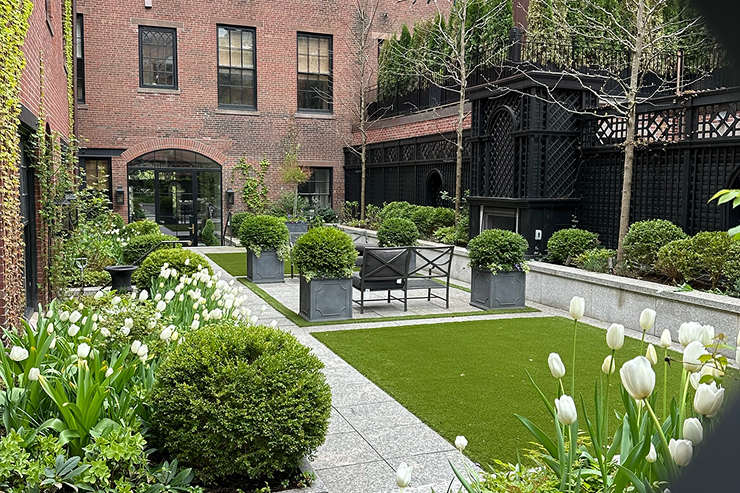
Structural pruning and shaping
Bed and border upkeep
Irrigation monitoring
Drip Irrigation Installations and Maintenance
Pest and disease scouting
Low-voltage lighting checks
Why Garden Maintenance matters in Boston specifically
New England’s growing season is short and front-loaded. What would be a leisurely spring elsewhere compresses here into about six weeks where soil warms, bulbs finish, and everything from pruning to bed prep has to happen before summer heat sets in. Miss that window and the plan spends the rest of the season catching up rather than staying ahead of it — a hedge that should have been shaped in April is instead shaped in July, after it has already pushed a season’s growth in the wrong direction. A maintenance calendar built for a longer, more forgiving climate simply doesn’t hold up here; it has to be compressed and front-loaded the same way the season is.
Properties near the harbor and in low-lying parts of Charlestown and the North End deal with salt spray carried in on winter storms and, on some blocks, salt used on adjacent sidewalks and streets through the winter. It browns broadleaf evergreens, stresses plants that would otherwise be reliably hardy this far north, and can set a garden back visibly by early spring if nobody checks it until the leaves are already scorched. Maintenance in these areas accounts for salt tolerance in what’s planted to begin with and includes rinsing and close monitoring after major coastal storms, rather than waiting for damage to show and then reacting to it.
Cambridge and Brookline, by contrast, are defined by deep shade from mature tree canopy — a different problem entirely, and one that gets worse rather than better as a neighborhood’s street trees and specimen plantings age. Turf and sun-loving perennials thin out under a hundred-year-old beech or oak, and a maintenance plan that doesn’t adjust plant selection and pruning for actual light levels will keep losing the same plants in the same spots year after year, at real cost, without ever addressing why. Selective crown thinning on the canopy itself, where it’s an option, and a shift toward genuinely shade-tolerant material where it isn’t, are both maintenance decisions, not just design ones.
From Newton west through the suburbs, deer pressure is serious and constant, and it’s the factor most new clients underestimate until they’ve lost a season’s planting to it. Hostas, arborvitae, and tulips disappear in a single night, often before a homeowner even realizes deer have been on the property. Maintenance in these towns has to include either deer-resistant plant choices worked into the existing beds over time, or a realistic protection strategy involving repellent applications on a schedule and, where appropriate, fencing — pretending the pressure isn’t there just means replanting the same losses annually and calling it bad luck.
Our process
Walk-through and assessment
Maintenance plan and schedule
Scheduled visits
Seasonal transitions
Ongoing adjustment
Where we do this work
We maintain gardens across Boston’s historic neighborhoods and the western suburbs, from dense townhouse lots to larger estate properties. In Beacon Hill and Back Bay, the work is mostly container and small-footprint bed maintenance on properties under historic commission review. Charlestown and the North End bring salt exposure and tight urban lots into the plan. The South End combines historic rowhouse gardens with a growing number of roof decks. In Cambridge and Brookline, deep shade from mature canopy shapes nearly every maintenance decision. Moving west, Newton, Wellesley, Weston, Lincoln, Concord, Chestnut Hill, Dover, and Sudbury are where deer pressure becomes the defining factor, and larger properties call for more extensive seasonal planning.
Related services
Garden maintenance is often paired with other work we do for the same properties:
- Garden Design & Installation — for properties starting from scratch or reworking an existing layout
- Fine Pruning — specialized structural pruning for specimen trees and shrubs beyond routine maintenance scope
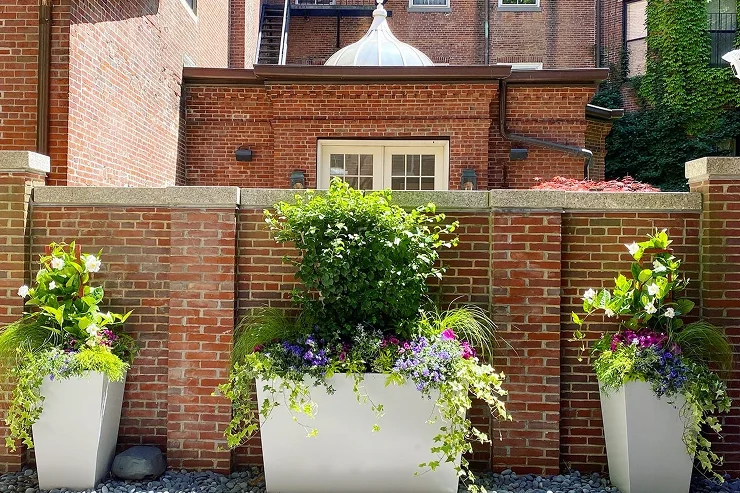
- Container & Window Box Planting — seasonal changeovers for entries, roof decks, and terraces
- Roof Deck & Terrace Planting — planting and care built for wind, weight, and drainage constraints
- Drip Irrigation Installation & Repair — new systems or repair of existing ones
- Low-Voltage Landscape Lighting — installation and seasonal adjustment
Get a maintenance plan for your property
Call (617) 720-2266 or request a consultation online. We’ll walk the property, assess what it needs, and send a written plan with a schedule and cost before any work begins.
Frequently asked questions
How often does a garden need maintenance visits in Boston?
Do you work with properties under historic commission review?
What does garden maintenance cost in Boston?
Can you take over maintenance on an existing garden you didn't install?
How do you handle deer pressure in the western suburbs?
What happens to containers and window boxes over the winter?
Do you offer one-time cleanups without an ongoing contract?
How does salt exposure near the harbor affect maintenance?
Who actually does the work — the same crew each visit?
Do you maintain properties with drip irrigation or lighting you didn't install?
Yes, we incorporate existing systems into the maintenance plan rather than requiring a full replacement. During the initial assessment we’ll flag anything that’s failing or nearing the end of its useful life so it doesn’t become a surprise mid-season.