- Serving Boston and the Greater Boston Area

- Home
- Services
- Garden Design Services
- Landscape Design
- Urban Garden Design
- Rooftop Garden Installation
- Roof Deck Planting
- Container Gardening Services
- Seasonal Container Planting
- Window Boxes
- Fine Gardening
- Garden Maintenance
- Planting Maintenance
- Flower & Plant Installation
- Drip Irrigation Installation
- Landscape Lighting
- Service Areas
Charlestown, MA
- Garden Services in Charlestown, MA
- Garden Design in Charlestown, MA
- Landscape Design in Charlestown, MA
- Urban Garden Design in Charlestown, MA
- Rooftop Garden Installation in Charlestown, MA
- Roof Deck Planting in Charlestown, MA
- Container Gardening in Charlestown, MA
- Seasonal Container Planting in Charlestown, MA
- Flower & Plant Installation in Charlestown, MA
- Window Boxes in Charlestown, MA
- Fine Gardening in Charlestown, MA
- Garden Maintenance in Charlestown, MA
- Planting & Maintenance in Charlestown, MA
- Drip Irrigation Installation in Charlestown, MA
- Landscape Lighting in Charlestown, MA
North End, MA
- Garden Services in north-end, MA
- Garden Design in north-end, MA
- Landscape Design in north-end, MA
- Urban Garden Design in north-end, MA
- Rooftop Garden Installation in north-end, MA
- Roof Deck Planting in north-end, MA
- Container Gardening in north-end, MA
- Seasonal Container Planting in north-end, MA
- Flower & Plant Installation in north-end, MA
- Window Boxes in north-end, MA
- Fine Gardening in north-end, MA
- Garden Maintenance in north-end, MA
- Planting & Maintenance in north-end, MA
- Drip Irrigation Installation in north-end, MA
- Landscape Lighting in north-end, MA
Downtown Boston, MA
- Garden Services in downtown boston, MA
- Garden Design in downtown boston, MA
- Landscape Design in downtown boston, MA
- Urban Garden Design in downtown boston, MA
- Rooftop Garden Installation in downtown boston, MA
- Roof Deck Planting in downtown boston, MA
- Container Gardening in downtown boston, MA
- Seasonal Container Planting in downtown boston, MA
- Flower & Plant Installation in downtown boston, MA
- Window Boxes in downtown boston, MA
- Fine Gardening in downtown boston, MA
- Garden Maintenance in downtown boston, MA
- Planting & Maintenance in downtown boston, MA
- Drip Irrigation Installation in downtown boston, MA
- Landscape Lighting in downtown boston, MA
Beacon Hill, MA
- Garden Services in beacon hill, MA
- Garden Design in beacon hill, MA
- Landscape Design in beacon hill, MA
- Urban Garden Design in beacon hill, MA
- Rooftop Garden Installation in beacon hill, MA
- Roof Deck Planting in beacon hill, MA
- Container Gardening in beacon hill, MA
- Seasonal Container Planting in beacon hill, MA
- Flower & Plant Installation in beacon hill, MA
- Window Boxes in beacon hill, MA
- Fine Gardening in beacon hill, MA
- Garden Maintenance in beacon hill, MA
- Planting & Maintenance in beacon hill, MA
- Drip Irrigation Installation in beacon hill, MA
- Landscape Lighting in beacon hill, MA
Boston, MA
- Garden Services in boston, MA
- Garden Design in boston, MA
- Landscape Design in boston, MA
- Urban Garden Design in boston, MA
- Rooftop Garden Installation in boston, MA
- Roof Deck Planting in boston, MA
- Container Gardening in boston, MA
- Seasonal Container Planting in boston, MA
- Flower & Plant Installation in boston, MA
- Window Boxes in boston, MA
- Fine Gardening in boston, MA
- Garden Maintenance in boston, MA
- Planting & Maintenance in boston, MA
- Drip Irrigation Installation in boston, MA
- Landscape Lighting in boston, MA
seaport, MA
- Garden Services in seaport, MA
- Garden Design in seaport, MA
- Landscape Design in seaport, MA
- Urban Garden Design in seaport, MA
- Rooftop Garden Installation in seaport, MA
- Roof Deck Planting in seaport, MA
- Container Gardening in seaport, MA
- Seasonal Container Planting in seaport, MA
- Flower & Plant Installation in seaport, MA
- Window Boxes in seaport, MA
- Fine Gardening in seaport, MA
- Garden Maintenance in seaport, MA
- Planting & Maintenance in seaport, MA
- Drip Irrigation Installation in seaport, MA
- Landscape Lighting in seaport, MA
back bay, MA
- Garden Services in back bay, MA
- Garden Design in back bay, MA
- Landscape Design in back bay, MA
- Urban Garden Design in back bay, MA
- Rooftop Garden Installation in back bay, MA
- Roof Deck Planting in back bay, MA
- Container Gardening in back bay, MA
- Seasonal Container Planting in back bay, MA
- Flower & Plant Installation in back bay, MA
- Window Boxes in back bay, MA
- Fine Gardening in back bay, MA
- Garden Maintenance in back bay, MA
- Planting & Maintenance in back bay, MA
- Drip Irrigation Installation in back bay, MA
- Landscape Lighting in back bay, MA
cambridge, MA
- Garden Services in cambridge, MA
- Garden Design in cambridge, MA
- Landscape Design in cambridge, MA
- Urban Garden Design in cambridge, MA
- Rooftop Garden Installation in cambridge, MA
- Roof Deck Planting in cambridge, MA
- Container Gardening in cambridge, MA
- Seasonal Container Planting in cambridge, MA
- Flower & Plant Installation in cambridge, MA
- Window Boxes in cambridge, MA
- Fine Gardening in cambridge, MA
- Garden Maintenance in cambridge, MA
- Planting & Maintenance in cambridge, MA
- Drip Irrigation Installation in cambridge, MA
- Landscape Lighting in cambridge, MA
south-end, MA
- Garden Services in south-end, MA
- Garden Design in south-end, MA
- Landscape Design in south-end, MA
- Urban Garden Design in south-end, MA
- Rooftop Garden Installation in south-end, MA
- Roof Deck Planting in south-end, MA
- Container Gardening in south-end, MA
- Seasonal Container Planting in south-end, MA
- Flower & Plant Installation in south-end, MA
- Window Boxes in south-end, MA
- Fine Gardening in south-end, MA
- Garden Maintenance in south-end, MA
- Planting & Maintenance in south-end, MA
- Drip Irrigation Installation in south-end, MA
- Landscape Lighting in south-end, MA
brookline, MA
- Garden Services in brookline, MA
- Garden Design in brookline, MA
- Landscape Design in brookline, MA
- Urban Garden Design in brookline, MA
- Rooftop Garden Installation in brookline, MA
- Roof Deck Planting in brookline, MA
- Container Gardening in brookline, MA
- Seasonal Container Planting in brookline, MA
- Flower & Plant Installation in brookline, MA
- Window Boxes in brookline, MA
- Fine Gardening in brookline, MA
- Garden Maintenance in brookline, MA
- Planting & Maintenance in brookline, MA
- Drip Irrigation Installation in brookline, MA
- Landscape Lighting in brookline, MA
winchester, MA
- Garden Services in winchester, MA
- Garden Design in winchester, MA
- Landscape Design in winchester, MA
- Urban Garden Design in winchester, MA
- Rooftop Garden Installation in winchester, MA
- Roof Deck Planting in winchester, MA
- Container Gardening in winchester, MA
- Seasonal Container Planting in winchester, MA
- Flower & Plant Installation in winchester, MA
- Window Boxes in winchester, MA
- Fine Gardening in winchester, MA
- Garden Maintenance in winchester, MA
- Planting & Maintenance in winchester, MA
- Drip Irrigation Installation in winchester, MA
- Landscape Lighting in winchester, MA
newton, MA
- Garden Services in newton, MA
- Garden Design in newton, MA
- Landscape Design in newton, MA
- Urban Garden Design in newton, MA
- Rooftop Garden Installation in newton, MA
- Roof Deck Planting in newton, MA
- Container Gardening in newton, MA
- Seasonal Container Planting in newton, MA
- Flower & Plant Installation in newton, MA
- Window Boxes in newton, MA
- Fine Gardening in newton, MA
- Garden Maintenance in newton, MA
- Planting & Maintenance in newton, MA
- Drip Irrigation Installation in newton, MA
- Landscape Lighting in newton, MA
lexington, MA
- Garden Services in lexington, MA
- Garden Design in lexington, MA
- Landscape Design in lexington, MA
- Urban Garden Design in lexington, MA
- Rooftop Garden Installation in lexington, MA
- Roof Deck Planting in lexington, MA
- Container Gardening in lexington, MA
- Seasonal Container Planting newton, MA
- Flower & Plant Installation in lexington, MA
- Window Boxes in lexington, MA
- Fine Gardening in lexington, MA
- Garden Maintenance in lexington, MA
- Planting & Maintenance in lexington, MA
- Drip Irrigation Installation in lexington, MA
- Landscape Lighting in lexington, MA
weston, MA
- Garden Services in weston, MA
- Garden Design in weston, MA
- Landscape Design in weston, MA
- Urban Garden Design in weston, MA
- Rooftop Garden Installation in weston, MA
- Roof Deck Planting in weston, MA
- Container Gardening in weston, MA
- Seasonal Container Planting weston, MA
- Flower & Plant Installation in weston, MA
- Window Boxes in weston, MA
- Fine Gardening in weston, MA
- Garden Maintenance in weston, MA
- Planting & Maintenance in weston, MA
- Drip Irrigation Installation in weston, MA
- Landscape Lighting in weston, MA
wellesley, MA
- Garden Services in wellesley, MA
- Garden Design in wellesley, MA
- Landscape Design in wellesley, MA
- Urban Garden Design in wellesley, MA
- Rooftop Garden Installation in wellesley, MA
- Roof Deck Planting in wellesley, MA
- Container Gardening in wellesley, MA
- Seasonal Container Planting wellesley, MA
- Flower & Plant Installation in wellesley, MA
- Window Boxes in wellesley, MA
- Fine Gardening in wellesley, MA
- Garden Maintenance in wellesley, MA
- Planting & Maintenance in wellesley, MA
- Drip Irrigation Installation in wellesley, MA
- Landscape Lighting in wellesley, MA
- Portfolio
- About us
- Blog
- Contact
- Flower Delivery
Drip Irrigation Installation in Downtown Boston, MA
A drip system on a Downtown Boston terrace has to survive conditions a backyard system never sees: constant wind moving across an exposed high-rise deck, a delivery schedule set by the building’s freight elevator, and a load limit that dictates how much soil and water weight the structure can actually carry. Get any one of those wrong and the planting fails by August, or the job never makes it past building management. We design the irrigation around the building first, the plants second.

What Drip Irrigation Installation looks like in Downtown Boston
Most of our Downtown Boston work is on roof decks and setback terraces attached to high-rise condominiums and Class A office buildings along the Financial District and the Rose Kennedy Greenway corridor. There is rarely any soil bed to speak of — planting is almost always in containers, planters, or built-in troughs on a waterproofed deck surface, which means every line has to be run, anchored, and terminated without penetrating the membrane underneath.
Light is usually generous up here — there is little tree canopy to block it and reflected light off glass towers can push exposure higher than a client expects — but wind is the variable that actually drives design decisions. A drip emitter that would irrigate a container fine at street level can be undermined by sustained gusts forty or sixty floors up, which dry out the top inch of soil faster than the schedule accounts for and stress root zones on the windward side of the deck differently than the leeward side. We zone accordingly, running higher-frequency, lower-volume cycles rather than a single long soak, and we favor pressure-compensating emitters that hold their output regardless of elevation changes across a long terrace run.
Access is the other defining factor. Every material — pipe, tubing, filters, timers, backflow assemblies, the containers themselves — has to move through a lobby, into a service elevator, and up to the deck inside whatever window building management allows that day. We plan material lists and delivery timing around that constraint before we plan the irrigation layout, because a system designed around parts that can’t get to the roof is not a plan at all.
What we account for here
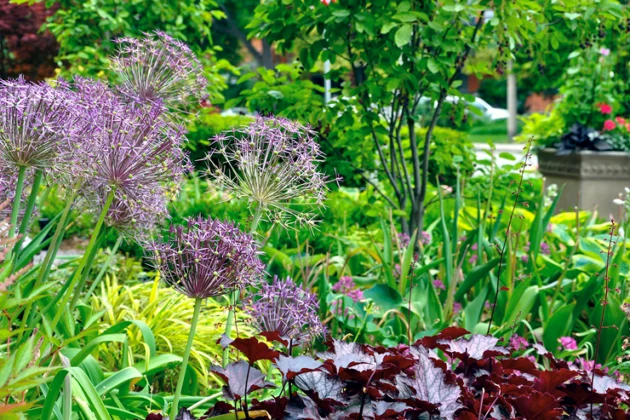
What we account for here
Freight elevator and delivery windows
Downtown high-rises book freight elevator time in narrow slots, often with a per-load weight or size cap and a strict window on either side. We schedule irrigation materials, soil, and containers as a single coordinated delivery sequence confirmed with the building’s property manager in advance, so the crew is never standing in a lobby waiting on an elevator that was booked for someone else.
Building management approval and structural load limits
Any addition to a terrace or roof deck — irrigation lines, filled containers, water reservoirs — has to clear the building’s load tolerance and, frequently, a written approval from the condo board or property management before work begins. We provide the specifications building management asks for, keep container and soil weights within the structural allowance the building sets, and route all documentation through the proper channel before materials ever arrive on site.
Wind exposure on high-rise terraces
Wind at height behaves nothing like wind at ground level, and it changes by exposure and by floor. We map each terrace for its windward and leeward zones and adjust emitter placement, cycle frequency, and container choice — heavier, lower-profile containers hold their footing better than tall narrow ones in a wind tunnel between towers — so watering keeps pace with evaporation instead of falling behind it.
No irrigation source on the deck
Many towers have no hose bib or water line already run to the terrace level. Where that is the case, we work with the building’s engineer to identify a legitimate tie-in point, whether that is a mechanical room line or a dedicated tap installed for the purpose, and we build the system’s pressure and filtration around whatever source that turns out to be.
Recent Downtown Boston work
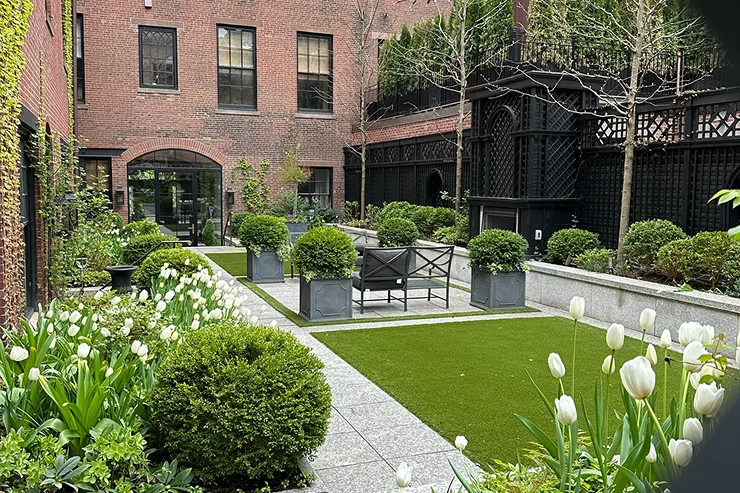
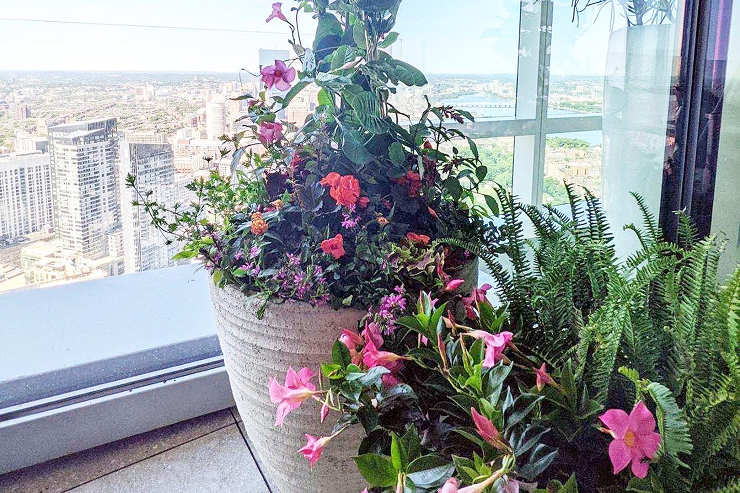
Recent work in the neighborhood has included fitting a zoned drip system to a 30th-floor residential terrace where every container had to be filled and planted on-site rather than moved up pre-planted, and retrofitting irrigation into an existing rooftop planting for a commercial building where the original setup had no automated watering at all and relied on staff hand-watering that could not keep pace with wind exposure. Both projects were built around the same two constraints: what the freight elevator could move, and what the building’s engineer would sign off on.
Other services we provide in Downtown Boston
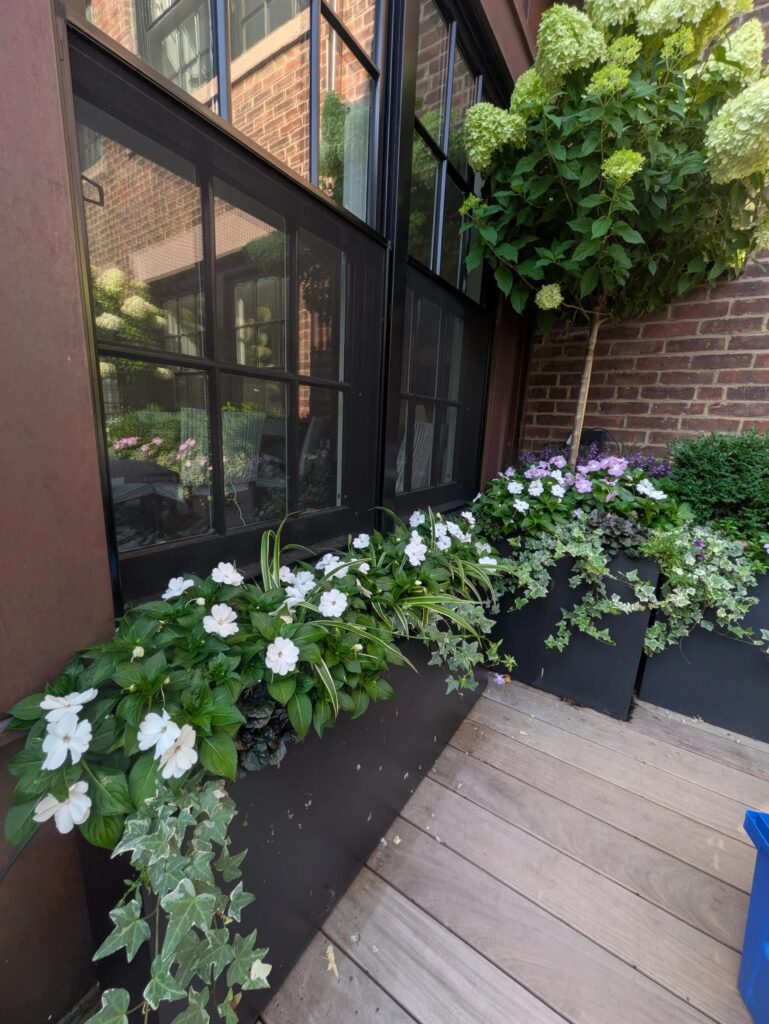
Drip irrigation is rarely a standalone request Downtown — it is usually one piece of a larger terrace or roof deck plan. We also provide full garden services in Downtown Boston, including container and window box planting for street-facing facades under historic guidelines, roof deck and terrace design and installation, fine gardening and seasonal maintenance for high-rise plantings, and low-voltage landscape lighting sized to the same load and access constraints that shape every irrigation job up here. If a project involves a rooftop or terrace, it is worth discussing drip irrigation and lighting together, since both share the same delivery window and the same conversation with building management.
Working across neighboring high-rise districts
The freight-elevator and building-approval realities of Downtown Boston are shared closely by drip irrigation installation in Beacon Hill and the North End, where similarly dense buildings and historic review add their own layer to terrace and rooftop projects. We treat these jobs as a family — the underlying engineering questions are consistent even where the architecture differs. For a wider view of how we approach drip irrigation across the city, see our Boston drip irrigation installation page.
Start with a consultation for your Downtown Boston terrace
The first step is a site visit to walk the terrace or roof deck, confirm the building’s freight elevator schedule and load limits, and identify a viable water source before any design work begins. Downtown Boston is roughly 1.6 miles from our Downtown Boston location at 5 Crescent St, and we work regularly with the building managers and condo boards across the district. Call to set up a consultation, and we will tell you plainly what the building will require, what the terrace can support, and what a realistic timeline looks like before any materials are ordered.
Drip irrigation for other parts of Boston
Downtown Boston’s rooftop gardens, courtyards, and streetside planters aren’t the only spaces that benefit from a well-fitted drip system. We install the same efficient, low-waste irrigation for properties throughout the surrounding city, from historic brownstone plantings to modern building landscaping.
Whether your property includes:
- Raised beds and planter boxes
- Rooftop and terrace container gardens
- Foundation plantings along building perimeters
- Small courtyard or pocket-park greenery
we bring the same careful layout and attention to water pressure and coverage. If you manage plantings at more than one Boston address, we’re glad to talk through a consistent irrigation approach for all of them.
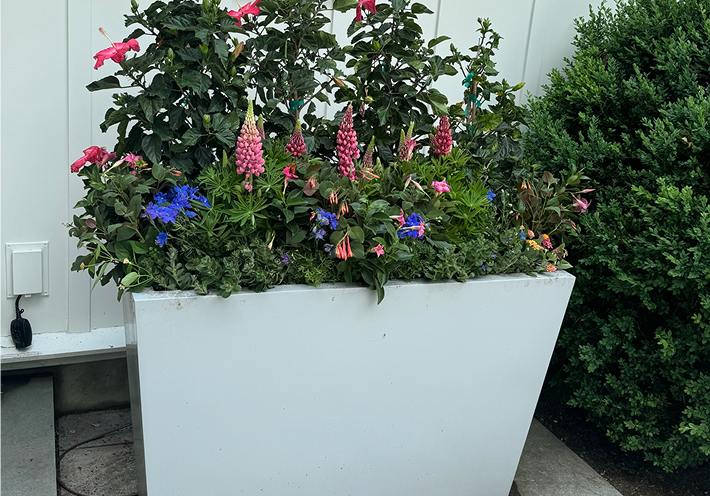
Getting your drip system right the first time
Planter boxes, rooftop gardens, and small courtyards in Downtown Boston all lose moisture quickly against brick and concrete, which is why a well-planned drip system matters. We map out water pressure, container placement, and sun exposure before any tubing goes down.
- Zoned lines for planters, beds, and containers
- Pressure-compensating emitters for consistent flow
- Discreet routing that keeps walkways and patios clear
What Our Customers Say
Frequently Asked Questions
Can drip irrigation be installed on a high-rise roof deck without damaging the waterproof membrane?
Yes. Lines are run and anchored using clamps and mounts rated for deck surfaces rather than penetrations into the membrane, and any fitting that must pass through a surface is coordinated with the building's engineer and sealed to their specification.
Does building management need to approve a drip irrigation project before you start?
In nearly every Downtown high-rise, yes. We provide the load specifications, material lists, and delivery schedule the property manager or condo board typically requests, and we do not begin work until that approval is confirmed.
How do you get materials and containers up to a terrace with no direct street access?
Everything moves through the building's freight elevator during a scheduled delivery window. We plan the full material list and coordinate timing with the property manager in advance so the crew isn't waiting on elevator access mid-installation.
Is wind really a bigger issue than sunlight for irrigation this high up?
Generally, yes. Reflected light off surrounding glass towers often means plenty of sun, but sustained wind at height dries containers faster than a standard watering schedule accounts for, which is why we run more frequent, lower-volume cycles and favor pressure-compensating emitters.
What if the terrace has no existing water source?
We work with the building's engineer to locate a legitimate tie-in point, such as a mechanical room line, and design the system's pressure and filtration around that source rather than assuming a hose bib is already available.